miércoles, 20 de noviembre de 2019

Stabbing and dashing: Galway Girl by Ken Bruen

If James Ellroy had a British disciple that person would be Ken Bruen. He's been around a long time has Ken, I recall reading a few his novels back in the mid 90s, one of my colleagues really loved him. I used to really love James Ellroy, but have to say I got stuck one third of the way through one of Ellroy's most recent novels, Perfidia, finding it just too excessive and hard going. So it was a relief that I was able to finish Galway Girl. But it did require a ginormous suspension of disbelief and not a little patience with the paradoxically impatient stabby dashy style. 

Galway's quite a small place, isn't it? So how come so many people get stabbed to death there and how come the bishop's cousin and the bishop himself... OK, don't ask. Don't stop to ask. Don't think. Just grip the prose and go for the ride. And there you have it. An unbelievable plot, unbelievable characters, lots of unbelievable action... But written with some brio and in an extremely. Punchy. Sort. Of. Style.

I think I quite liked it...


viernes, 18 de octubre de 2019

Consejos de una Remainer a los que se oponen al procès


Consejos de una oponente del Brexit a los que os oponéis al procès... Tengo que empezar con una disculpa. Disculpádme por no escribir en Catalan, de momento lo estoy aprendiendo y no podría expresar todo lo que siento que tengo que expresar.

Los que apoyamos a Remain en el Reino Unido estabamos siempre a la zaga y, es mas, parece, hoy 18 octubre 2019, que estamos casi a punto de perder la guerra contra el Brexit. Se puede aprender mucho de un fracaso, las lecciones que se me occurren, son los siguientes:

1º. Actuad pronto. Actuad AHORA, porque de momento ellos tienen la iniciativa y llevan las de ganar.

2º. No os calléis. Nunca. No os ocultéis. Nunca. Si sale un indepe en la prensa, en el televisor en el medio que sea, procurad que alguien de vuestro lado salga también y hablando Catalán y cuanto más rango tenga, mejor.

3º. Nunca dejéis, por educación o reparo, que lleven ellos la voz cantante, porque si lo hacen, os aplastarán y encima ellos no tendrán ese reparo. Apareced en los mismos medios, discutid y disputad punto por punto sus mentiras. Preparaos bien y refutad las mentiras y exageraciones del otro lado. ¡Pero, ojo! La preparación NO SIRVE DE NADA si no se divulga en un medio poderoso como la tele o los medios sociales más pujantes.

4º. No dejéis nunca de presionar los políticos, del partido que sea, mejor, DE TODOS LOS PARTIDOS (menos, quizás que Vox, que esos os harán aparecer tal y como los indepes quieren que aparezcáis), de centro, izquierda y derecha. Ellos tienen sus partidos, vosotros también.

5º. Como todos los nacionalistas, harán trampas, mentirán, malversarán fondos, corromperán cargos públicos… No os sorprendáis cuando se descubra que esto esté ocurriendo. Porque ocurrirá así es como operan los nacionalistas. Sin escrúpulos. No contéis con la justicia o el gobierno, son demasiado lentos y puede que ya hayan sido infiltrados. Por supuesto no dejéis de denunciarlos, pero adoptar tácticas semejantes, al menos a corto plazo, puede ser una consideración.

6º. Sed coherentes y cohesivos. Es natural que haya disputas y divergencias, pero procurad socavarlos, al menos en público, montad mesas de coordinación para unificar mensajes, concentrad en lo que os une, no en lo que os divida, nunca les deis un resquicio por donde puedan colarse. Y tened en cuenta que hay muchas formas de protestar, que tu adoptes un camino no quiere decir que el que adopte otro es invalido, no. Sed solidarios y tolerantes con vosotros mismos.

7º. La financiación es fundamental pero no lo es todo, ni mucho menos. La visibilidad vale tanto o más; también, la movilización, las protestas y las huelgas. 

A mi modo de ver una de las cosas que más debilitó al movimiento Remain era que la major parte de sus seguidores parecían ser manifestantes de fin de semana, solo disponibles el sábado porque estaban trabajando. Hasta se aplazó una manifestación que se tenía convocada porque se descubrió que ese mismo día un centro hospitalario tenía un evento caritativo. Esto, injustamente quizás, da la impresión de desidia, de poca convicción, de pasividad. NO. Vuestra causa, es LA CAUSA. Nunca cedáis a otro. No, dinero no basta. Hay que dar la cara, estar en la calle, en los medios, en todas partes. Vociferantes y protestando.

8º. Nunca olvidéis, si perdeis, LO PERDÉIS TODO, LO PIERDEN TAMBIÉN TUS HIJOS Y POR MUCHO TIEMPO.

Buena suerte a todos, nos hará falta...


domingo, 13 de octubre de 2019

We need to talk about Catalan Nationalism: The Politics of Regression


On Monday 14 October 2019 the Spanish Supreme Court is set to deliver its sentence on the high-ranking Catalan politicians put on trial for holding an illegal referendum on Catalan independence on 1 October 2017.


The illegal referendum of 1 October 2017 and its aftermath[i]

There are many myths surrounding this referendum and I will attempt to dispel a few of them below. Firstly, let’s get this very clear, the referendum was illegal. It was in breach of both the Spanish constitution and the governing law of the Generalitat, the regional authority of Catalonia holding it.

An analogy might help here, it was as if I were to hold a referendum on my street in the UK becoming independent of the rest of the UK and consequently, exempting myself from having to pay any taxes to the UK government and obey parliamentary mandates or UK law. One afternoon, over a few drinks, I get together in my garden with a few friends and we all vote in favour of holding this referendum. A few weeks later we park a few urns in the street, suggest that our neighbours, but only those in favour, print off their own ballot papers at home and deposit them in said urns. Obviously, the result turns out to favour the independence of my street, and consequently I declare my street independent. This is of course setting to one side the fact that the referendum had no legal validity or effect and that the vast majority of those taking part in it, less than 50% of the people actually living on my street, were in favour of only one side.

Effectively this was what happened on 1 October 2017 in Catalonia. You don’t believe the bit about the ballots being printed at home? Well that actually was the case.

The Spanish state had to react quickly and late to what was going on. Mainly because the Catalan regional police, the Mossos d’Esquadra, showed themselves to both inept and partisan, favouring the nationalist government and dragging their feet when it came to stopping the illegal vote.[ii]

Given the urgency, Rajoy’s PP (Conservative) Government scuppered the Civil Guard and sent it in to complete the confiscation of the urns. Crowds resisted and there were several confrontations. But despite the Catalan nationalists milking this for all it was worth, there were no deaths and barely a handful of injuries.

One young woman claimed for example that her fingers had been broken, it turned out she had a single swollen finger. When it was all over four people had to be kept in hospital.[iii]
The Catalan Regional Government said it would assist private citizens to sue the state.[iv]

There are still some 28 cases ongoing in 26 regional courts, but not all involve violence, some involve the misuse of personal data and some are complaints made about local mayors who allowed urns to be placed in their neighbourhoods… 

Because you see, and this is an essential point, not all Catalans support independence, in fact more than half do not. Recently, this schism has even spread to the Mossos, with pro-Spain and pro-Catalan Independence officers having running arguments online.[v]

An endogamous political class

Further to the above, however, there is a very stark difference. The Catalan independence movement is almost completely inbred, it is dominated by a particular group of related people. Genealogy has become very popular hobby in recent years, and even at its most basic level that of the surname borne by people it can tell us a lot. This is particularly true of Catalonia and the nationalist movement.

The most common surnames to be found in Catalonia will sound familiar even to English ears, because they are also the most common Spanish names found in the rest of Spain and South America, names like López, García, Martínez, Pérez, Fernández, González and Sánchez.

All these names are of Castilian origin (the termination “ez” means son/daughter of, so that would be the child of Lope, of Martin, Pere or Pedro, Fernando, etc. etc.). It would be expected that such names would appear in equal frequency among those holding political positions in Catalonia. The fact is, they don’t.

Modern Catalan politics and especially the independence movement is governed by people with Catalan surnames, such as Vila, Serra, Solé, Vidal, Bosch, Pujol, Font and Puig (I had to declare an interest here, my own surname could be characterised as a Catalan surname rather than a Castilian one). It turns out that people with surnames borne by only 13% of the general population of Catalonia, hold 40% of the posts in the Catalan political administration[vi]. Something very similar happens with first names, where Catalan Christian names clearly predominate in the political class but not in the general population.

In other words, the cupola of Catalan nationalist politics is a segregated, exclusive world and access to it may depend more on who your family were, if your grandparents were born in Catalonia or outside of it, rather than on merit. The basic truth is that Catalan politicians are unrepresentative of the current general population of the Catalan provinces.
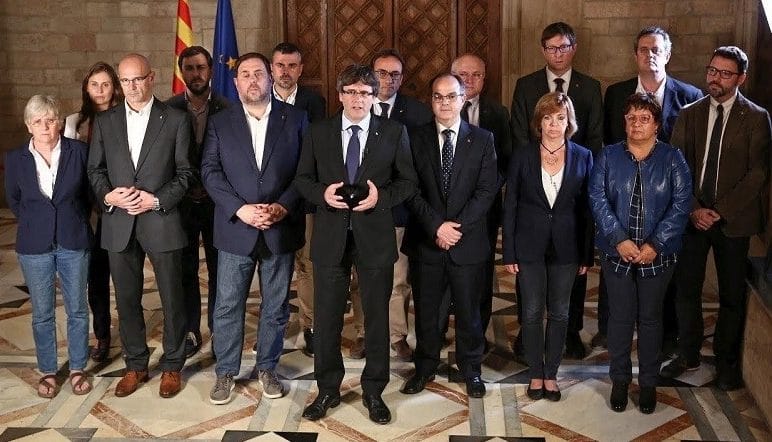
Finally, I should mention that of the 13 Catalan political leaders currently on trial for the illegal referendum: Carles Puigdemont, Oriol Junqueras, Joaquim Forn, Jordi Turull, Raül Romeva, Clara Ponsatí, Josep Rull, Toni Comín, Dolors Bassa, Carme Forcadell, Marta Rovira, Jordi Sànchez and Jordi Cuixart, only one, Jordi Sànchez, does not have a traditional Catalan surname.


The politics of Catalan nationalism

Given the above it would be unsurprising to discover that Catalan politics and the independence movement are in fact highly conservative.

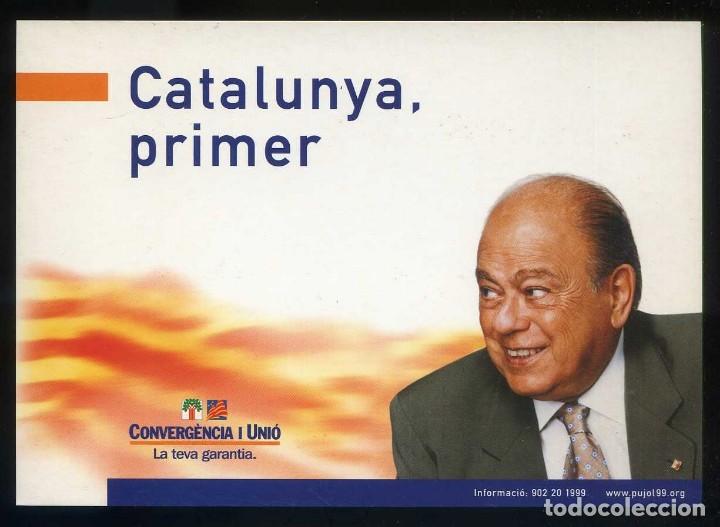
Here is a poster from Convergència i Unió, one of the premier nationalist parties in Catalonia. Yes, you read it right, it says “Catalonia first”. It is from 1999, years before the orange groper rocked up to the Whitehouse. The man in the picture is Jordi Pujol, party leader and leader of the regional Catalan government, the Generalitat for 23 years, only a handful of politicians could claim as many years at the top.


Mr Pujol and his family have been indicted of concealing public money in private bank accounts in Andorra, Switzerland, Jersey, Cayman Islands and other tax havens in excess of €100 million during his time in power.[vii] It is noteworthy that significant parts of the Catalan nationalist elite circled the wagons around the Pujol family (his three sons are also involved) and have so far managed to protect them from the normal consequences that such charges usually bring.



A second Convergència i Unió poster, this time from  2013 lays bare one of the main driving forces behind the nationalist movement, “Subsidised Spain lives off productive Catalonia” is the slogan, in other words, the main objection of the Catalan nationalists to being part of Spain is that they see themselves as subsidising the rest of the country. It becomes obvious that despite appearances, what is really lurking behind the recently developed queasy smiley logo is money and vested monetary interests, not to say the exceptionalism of believing that only the Catalans work in Spain and only they produce income. 


It is abundantly clear, then, that the Catalan nationalists are not progressives. Another aspect here is to consider their relationship with the catholic church. Catalan nationalists love to describe the rest of Spain as backwards, repressive and fascistic still trapped in the era of the long-lasting dictator Francisco Franco, who died in 1975.
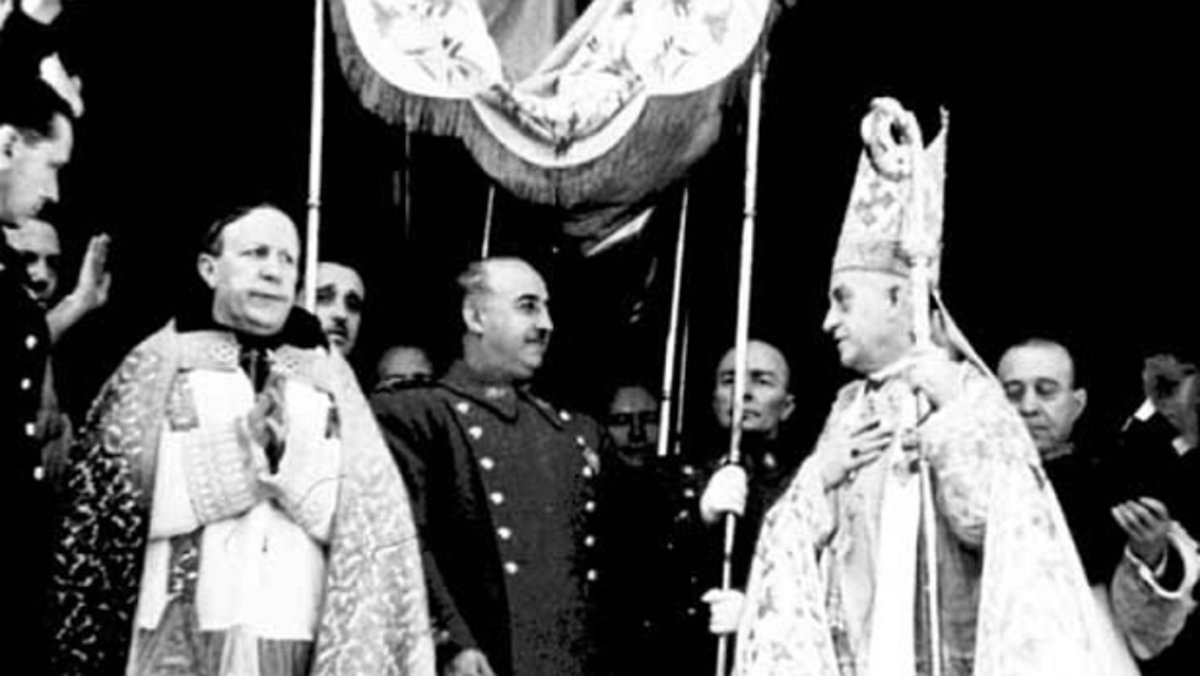
One of the main traits of the Franco dictatorship was the mutually beneficial relationship between it and the catholic church. The catholic church was then, like the catholic church in Ireland, an intolerant force of repression. Franco was a favoured son to the extent that when he visited any church in an official capacity, he was ushered in under a canopy.


While the Catalan nationalists proclaim to the four winds how socially advanced they are and how they aspire to create a “Catalan Republic” it seems their relationship with the catholic church in the 21st century bears an uncomfortable resemblance to that of Franco.[viii]


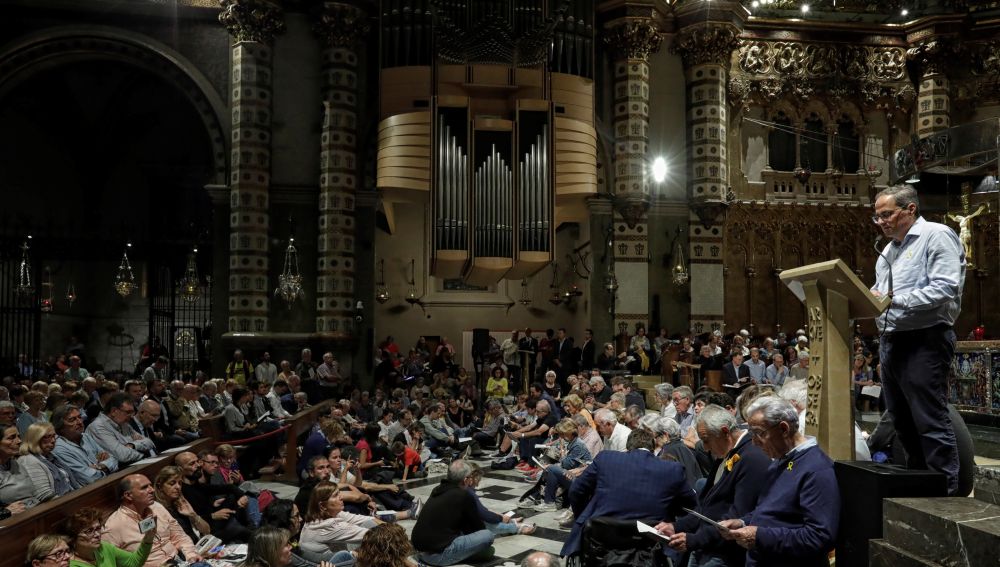
Above you can see the current head of the Generalitat, the nationalist, Quim Torra i Pla  leading prayers for the so called “political prisoners” last Sunday (6 October 2019) during a mass in the monastery of Monserrat. The monastery which is a very large building was so full that people are sitting on the floor. Past head of the Generalitat, Jordi Pujol was also in attendance.

It should be highlighted that Monserrat is not just any monastery. The abbot recently admitted he was complicit in concealing multiple cases of child abuse.[ix] And yet the Catalan independents still think this is a great place to hold their little ceremony.

This did not happen years ago, it was in the media last month, September 2019, but the independence "rebels" considered it an appropriate venue. The predator was nicknamed "Andreu Manos Largas" "Andreu Longhands" he was a catholic scout troop leader based in Montserrat and a priest.

One of the victims, Miguel Ángel Hurtado, says that he believes that political representatives (yes, that would include those heading the Generalitat during the illegal independence referendum), were dragging their feet when it came to acting on child abuse.

In conclusion, when the Catalan nationalists start to rant about “backwards Spain” or “corrupt Spain” and compare themselves to Gandhi, Martin Luther King or Nelson Mandela, please bear this in mind, they are not really progressives, they are not poor, they are not powerless, they are not untainted by corruption, they are not freedom fighters and they are certainly not human rights martyrs. They are a close tribal caste of opportunists, avaricious wolves in liberal sheep’s clothing, they are in it, like most nationalists, entirely for themselves… And the power, and the money, of course, it is always about the money.


[i] https://www.elconfidencial.com/espana/cataluna/2018-10-01/1octubre-cataluna-cronologia-referendum2017_1622549/
[ii] https://elpais.com/elpais/2018/01/10/inenglish/1515574330_704678.html
[iii] https://elpais.com/elpais/2017/10/04/inenglish/1507104937_874487.html
[iv] https://www.elperiodico.com/es/barcelona/20171002/barcelona-ayudara-a-heridos-por-el-1-0-a-denunciar-6326888
[v] https://sociedad.e-noticies.es/mossos-balcanizados-126424.html?rnd=787
[vi] https://drive.google.com/file/d/0B9K3QsORGY1ZblpJTTQ5WFpjNkk/view
https://www.vozpopuli.com/espana/Artur_Mas-Generalidad_de_Cataluna-Jordi_Pujol-Casta-Endogamia-Apellidos-xx-CiU-Gobierno-Cataluna-endogamia-casta-elites_0_758024197.html
[viii] https://www.lasexta.com/noticias/nacional/torra-asiste-a-una-plegaria-en-el-monasterio-de-montserrat-en-solidaridad-con-los-presos-independentistas_201910065d99e5630cf2b33c9d0c0dfa.html
[ix] https://cadenaser.com/programa/2019/09/06/la_ventana/1567787095_452066.html

sábado, 7 de septiembre de 2019

Enticing Egypt: The Awakening Aten by Aidan K. Morrissey

Many, many thanks to NetGalley for providing me with an early copy of this text.
History was a favourite subject at school so I do enjoy a historical novel every now and then. Unsurprisingly history novels are very much of their time, so while there's always been an abundance of mediaeval set novels from the Victorians onwards, in the latter part of the 20th and the beginning of the 21st centuries, given the interest in political structures and democracy, there has been a veritable flood of Rome-based novels. 
Novels based in ancient Egypt however have fared much less well, I suspect the reason for that is that white Westerners mostly struggle to find some way of identifying with ancient Egypt. Off the top of my head I can only recall two novels set in Egypt, Ancient Evenings by Norman Mailer, and Sinhue the Egyptian, by Finnish novelist Mika Waltari. I would never recommend Ancient Evenings to my friends, I don't know what Mailer was on when he wrote it, but I wouldn't like to share that either. Sinhue, on the other hand, is a veritable classic and when I read it in high school I could simply not put it down. 
The Awakening Aten is set in roughly the same time period as Sinhue, as its title indicates, in the time surrounding the reign of the heretic King Akhetaten (in the introduction the author informs us that the Egyptians never themselves used the term Pharaoh). This shared setting is no coincidence, Akhetaten boldly attempted to break with centuries of religious tradition and establish a new more streamlined cult of a single god rather than the confusingly multifarious deities traditionally worshipped in the land of the two Niles, thus the era has an enduring appeal to the modern mind. 
The story begins with four men awaiting execution for different offences, an artist, Kha, a thief, Pernab and an exile, Yusuf (later Yuya). The story follows the fortunes and misfortunes of the three men once they manage to dodge their fate and their families which become inextricably intertwined with the story of Egypt at that time and that of the Royal family itself in a time of upheaval. This is an interesting novel because it is based very closely on archaeological findings, this has both advantages and disadvantages, the advantages are that you will learn a great deal about the Egypt of that time, tomb painting and architecture, religion, crime and punishment, the priesthood, military campaigns, the Royal family et cetera the disadvantages are that sometimes the book loses itself in description rather than advancing the plot. There are all some sequences of extreme brutality. Overall it was quite a compelling saga, although occasionally the characters sound very cardboardy, but be warned, it ends on a cliffhanger.

sábado, 24 de agosto de 2019

A Demon off the rails: The End of the Line by Gray Williams

I found the premise of this novel deeply impressive and disturbing. An uber-capitalist contemporary world where magic, practitioners of magic and Demons exist but are co-opted by those at the top and organised crime.
The first few pages of this novel are a very good taste of what you're going to get. The beginning was so abrupt that I thought for a moment that I was reading a second novel in a cycle. I loved it.
There are no goodies in this book, just characters who are grey to varying degrees. And a Demon who has managed to escape from the influence of his summoner who is the darkest pitch of black. Readers should also be warned that it is incredibly violent.
The basic plot is a simple one, a daemon has been summoned, manages to escape, and we follow a group of shady characters, who, for various reasons, have been coerced by an organised crime boss into the attempt to eliminate him. This is no small task given his extreme powers and his ability to possess human minds and thus wreck havoc.
The characters are hit and miss, our protagonist has her memorable moments, curiously it is the second time in a few months that in a modern fantasy book I have found an ethnic minority female protagonist called Amanda... Guys, yes we have to love "Amanda", but please find some more original names! On the other hand I really did like that the name given to the Demon's not fancy nor Greek nor Hebrew nor Latinate.
The story lags somewhat towards the end, cycling back and forth between the same group of characters in the same confined area does get somewhat tedious. And the resolution struck me as rather contrived, but for all this, this novel has strength, the power to shock and an almost daemonic energy... One scene in particular sticks in the mind.
I'm hoping for second helpings!
 #TheEndOfTheLine #NetGalley


jueves, 18 de julio de 2019

A worthy effort: Shepherd's Warning by Cailyn Lloyd


Thanks as always to NetGalley for allowing me to read an early version of this book.

It is to this writer's credit (and those of her editors) that I did not realise that this novel was self-published until the last page. It is a passable horror story centred around a haunted Elizabethan mansion in Wisconsin USA. I seem to have hit a slew of books lately where the protagonist is particularly unmemorable and, unfortunately, this novel is no exception. For all of her seventh sight, incipient epilepsy and love for her granddaughter, I found it very difficult to get emotionally invested in Laura McKenzie. Her breakup with her husband should also have been emotionally wrenching to lend the tale more excitement but was just sudden and rather dull. Sometimes the prose is also quite tedious, the "room cants sideways" numerous times as our heroine hits the concrete, or should that be the wooden flooring? Also, it was never clear to me why she seemed to be the sole custodian of her granddaughter following her son's death... Where was her daughter-in-law? Oh well.

For all of that it was pretty readable although I would hardly describe it as unputdownable.

jueves, 4 de julio de 2019

Tricky: Trixy by Elizabeth Stuart Phelps

I admit that when I first saw this book posted on Netgalley since I was at bit of a loose end I decided to take it on as a sort of challenge. Trixy is a novel first published in 1904 and this, obviously, is a re-edition with an academic purpose which is in part to rehabilitate Elizabeth Stuart Phelps and also take another critical look at the development of the animal rights movement. But for me the question was, could I finish it?

Professional ReaderEventually the answer was "Yes", but not without a long hiatus in the middle in which I read a few other books which were more to my taste. The problem with Trixy is that it is very much of its age, it is melodramatic, over-sweet and has some very dense patches of purple prose, at crucial stages it also elides certain information by openly stating something along the lines of "I cannot describe this , it will be too hard on my readers" which I found patronising and somewhat insulting.

The first problem I had was with the heroine, who is not Trixy (Trixy is actually a little white poodle), but a very tenderhearted young lady of some means. She is a very stereotypical character which very few novels would get away with today. She is the amiable landlady of a bunch of 'umble tenants who for some reason that escapes me, love her to bits, oh, sorry that's right, they love her because she's so kind! Among her tenants is a frail crippled lad who is Trixy's owner as a way of making some sort of living he has taught the poodle to perform some tricks. This young lady is also courted by two gentlemen, one is a doctor and the other is a lawyer.

In a fairly novel approach, which is a former lawyer I cannot but applaud, the doctor turns out to be a baddie and the lawyer a goodie. For the simple reason that the doctor is a vivisectionist. At a crucial point, Trixy disappears, and well... You'll have to read the book as I did.

Apart from the melodrama the purple prose the hackneyed plot, this novel does have some redeeming features, that is a very good study of the coarsening of some members of the medical profession. I've had quite a few illnesses of my own in my time and therefore I've met many doctors physicians and nurses, most were fairly nice human beings, some were superb, and others, how shall I put it? Didn't seem to give a fuck. Phelps portrays this very well and in my view rightly attributes this deficiency to two main causes, the first being that some members of the medical profession are not very nice people to begin with and have joined the profession as a means of enhancing their status, exercising power or even giving free rein to their sadistic impulses. The second, and most original approach in my view, is that they have been bent and twisted and rendered indifferent by having too much power over animals and people. This group started off well, but had to harden itself in order to progress and have lost touch with an important part of their humanity.

For me this insight seems to be more valuable than the author's all encompassing anti-vivisectionist stance. At some point in the book she hints that she is condemning only unnecessary vivisection... But it doesn't seem to me that she modulates this. I am a pet owner I love animals but that is not the same as failing to recognise that in many instances experimenting on animals has helped medicine progress, indeed this is an argument that she puts in the mouths of one of her doctor characters but she actually only does so to discredit it.

There are some good scenes in this novel, one in particular I think will always stick in my mind. And as I said above it is in some ways very perceptive, but I am not sure that overall these two traits overcome the setback of what is a very dated text.